Showing posts with label heroes. Show all posts

Monday, March 11, 2013

You Are Being Watched

We were in a fast food place the other day. I was pouring a cup of diet Coke from the fountain. I didn't even think about it, because I had done it so many times. Place the cup under the ice dispenser, get ice, put the cup under the Diet Coke spigot, push the button, fill the cup up near the top. Wait for the bubbles to disperse. Fill it up again, and wait again, and then fill it to the top.

That's just how you do it.

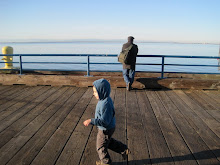
And then I realized I was being watched by a pair of seven-year-old eyes.

It's a humbling thing, seeing your child watching you. I wish I had been doing something really cool, like recoding a website or dismantling a carburetor. Or cooking the perfect omelette. But instead, I was just pouring a cup of soda. And my kid was watching me to see how to do it.

It must happen all the time. All the things I do all day that I don't even think about, and he just studies me like a walking textbook. Pouring cereal. Tying my shoes. Making coffee. Shaving my face. So many things.

I remember doing it myself, of course. I have clear vivid memories of watching my dad as he did the simplest things, things he hadn't even realized were things, if you see my point. Things like parallel parking. Like throwing a football in an effortless spiral. Like ordering food in a restaurant. And I watched him, because that's how you learn how the world works. You watch your parents. And the way they do things is the way that it's done.

Is that a little scary, parents and parents-to-be? Good. Because you need to keep it in mind. You are being watched all the time. Whatever you're doing - good, bad, lazy, admirable - your children have their eyes on you. Make yourself someone worth watching.

Photo from flickr user @ANDYwithCAMERA. Used under Creative Commons license.

Monday, March 28, 2011

A Genuine Hero


One of Seattle's finest citizens, Irene Hull, has died.
A week to the day before her death, she attended her Communist Party club meeting in Seattle. Someone announced the Saint Patrick's Day rally in Olympia to protest budget cuts and to demand that the legislature "tax the rich." Hull spoke up: "I'll go if someone picks me up."

She was a tiny dynamo, two inches shy of five feet tall, barely over 100 pounds. She became a national labor heroine when the Seattle chapter of Jobs With Justice (JwJ) published a poster in 1995 of several enormous police officers arresting Irene Hull.
Lonnie Nelson, a Seattle JwJ leader and a member of Irene's CP club, recalled that day. "It was during a sit-in at Republican Party headquarters to protest their attacks on Medicare," Nelson said. "When the Seattle police told Irene to move, she told them, 'I'm going to go limp.'

"So they handcuffed all of us, hauled us out and put us on a transit bus and took us to the county jail," Nelson continued. "They had us in jail for hours. We sang union songs. We talked about standing up against the vicious Republican attack on Medicare. Through it all, Irene's big concern was my wrists aching from those tight handcuffs." Nelson laughed merrily at the memory.
I was privileged to get to know Irene when I was a community organizer. I took her to a couple of rallies and protests in Olympia. I sat with her at labor meetings and saw her at just about every protest I ever attended in the state of Washington. When I marched with 50,000 labor activists during the WTO protests, Irene Hull was there.

She was one of the most dedicated and selfless people I've ever known, and a genuine hero of mine. Without her, Seattle may be a quieter place, but it will surely be a sadder place.

Wednesday, February 11, 2009

Heroes: a Rant


Great. So now Daphne's dead. One more female character goes on the scrap heap.

It continues to disturb me how few strong women are on this show. Claire's the strongest and most visible of any female character, and what's her power? She can come back from any injury! She's the ultimate victim! She can't do anything offensive, but boy, can she take a punch!


Daphne was great, but Daphne's dead or injured. Elle was awesome, but she's dead (and seen above, smoldering.) Monica was great, but she's disappeared. I loved Candice, the one who could make illusions, but she's dead. Eden? Dead.

Maya was always a victim of her powers. ("Noooooooo! Ay dios mio!") I couldn't care less if she ever resurfaces, unless she's running an army of pissed-off, empowered Latinos.

And then there's the schemers. Mama Petrelli is basically Lady Macbeth - conniving and fickle, which is a bad combination. She can see the future in her dreams - also not really an offensive power. Tracy's all right, but like Mama Petrelli, she's more known for her conniving than for her power. And anyway, she's in some kind of X-Men Abu Ghraib torture chamber now. And remember - Daphne started out as a double agent for Linderman, but then she fell in lurv with Parkman and turned to the righteous path.

So who's the rebel army on the run right now? Matt, Peter, Hiro, Mohinder, and Ando. Five men. Meanwhile, Claire is told to sit at home and be a good little girl. Maybe I watch too much Joss Whedon, but why isn't there a single woman in this show who's not a victim, a corpse, or a schemer?

Thursday, September 06, 2007

The Lucifer Effect


Mirrored sunglasses.

Billy clubs.

Surplus army uniforms.

That's all it takes to turn a "normal," healthy college kid into a marauding warrior, an intimidator, a menacing figure that strikes fear into the prisoners he guards.

Who were also college kids.

It doesn't take much to tip the average human over from sensitive to insensitive, from feeling to unfeeling, from human to ... no longer human.

I just finished reading The Lucifer Effect by Phil Zimbardo. Zimbardo was the man who designed the infamous Stanford Prison Experiment, during which two dozen Stanford students were divided into groups of "prisoners" and "guards" - selected by random - and installed in a makeshift prison. The experiment was scheduled to last for two weeks. Just two weeks. But after six days, the "experiment" had turned into chaos.


Guards tortured their prisoners, forced them to do humiliating and demeaning exercises, threw them into solitary confinement for arbitrary reasons, did everything they could do to crush the spirits of their captives.


The prisoners resisted, fought, attempted to escape, mounted hunger strikes and civil disobedience, went mad, sunk into dangerous depression, and convinced themselves they would never be released. Some were released for their own protection, for the sake of their rapidly deteriorating health - after two days. The remaining prisoners - fueled on their own paranoia and fueled by the behavior of the guards and the prison's "supervisors" - decided that the experiment was real, that they were prisoners in a genuine prison, not college students being paid $15 per day to participate in an experiment.

Everyone - the guards, the prisoners, the psychologists who videotaped and recorded and watched the "prison" - went mad.

The experiment lasted for just six days. Finally, someone - someone who had not been part of it, had not been watching and soaking in the toxic atmosphere, someone who had fresh eyes and could see clearly what was happening - blew the whistle. Christina Maslach, a graduate student (who went on to marry Zimbardo), surprised herself by insisting that the experiment was not an experiment, was not in fact moral. It was a torture chamber that had to be shut down.

Zimbardo takes the lessons learned - including his own complicity in the events of the Stanford Prison Experiment - and explores how ordinary men can turn evil, given the right circumstances and the right supervision - or lack thereof. He sees parallels in the experiment, conducted in 1971, and the recent revelations of torture, abuse, and even homicide in the Abu Ghraib Prison. In both places, a lack of responsible supervision, dehumanization of both the guards and the prisoners, and an overall atmosphere of impunity and lawlessness inspired the abuses. Evil, postulates Zimbardo, is not something that only happens to certain "bad apples." Evil can happen to any of us. Anyone can turn, given the right combination of circumstances and inner makeup. It's not about bad apples, it's about bad barrels that rot the apples within.

But the converse of this is what gives us all hope. "The banality of heroism" is a true corollary to the much-discussed banality of evil. Just as anyone can sink into the depths of madness, tormenting and dehumanizing his fellow man, anyone can rise to become a hero - one who can cry for fairness and justice, despite the behavior of those around him. Anyone can become a Gandhi, a Mandela, a Joe Darby. We just need the right combination of circumstances and inner makeup. The right stuff, as it were, combined with the right opportunity to rise. We can all be heroes.

These issues - the nature of evil - is something that's fascinated me since I was in college. One of these days, I'll share the story of how it all started. But I've been reading books like this for a very long time - about evil, about Nazi psychology, about war and the warrior mentality, about the darkness that lives in your heart and mine. But this may be the best of them, and certainly it is the most hopeful about the nature of the human spirit. Read it.