Tuesday, November 04, 2008
The Future
Go vote, if you haven't already. I voted for Obama, Chris Gregoire, and I voted yes on Initiative 1000. I would have voted for Darcy Burner, but I'm not in her district. That's as much as I'm going to share about my choices.
Stop reading. Go vote. Do it now. Get yer free coffee or your free ice cream or your free I have no idea what this thing does, but go vote.
I'm on pins and needles waiting for the results to come in, but I think it's going to be a very good night tonight.
Thursday, August 28, 2008
Barack Obama, My Candidate
Barack Obama is just eight years older than me. He is of my generation - the generation that missed the sixties, the generation that grew up under the specter of the Cold War and Richard Nixon and Ronald Reagan. He is my candidate, the first candidate with whom I could truly emphasize.
I loved his speech tonight, but two parts in particular jumped out at me. He built a strong case for the power of government - yes, the federal government itself. The big bad bureaucracy. Like me, Obama believes that government is not only necessary, but is in fact the proper mechanism to tackle society's problems. Like me, he believes that government at its best works on our behalf and in line with our best instincts.
What is that American promise? It's a promise that says each of us has the freedom to make of our own lives what we will, but that we also have obligations to treat each other with dignity and respect.He also recognizes that not everybody believes him. He spoke directly tonight to the people who have given up on politics, on government, and maybe they've even given up on him. And he pointed out how that apathy was far from benign - that ignoring politics would merely let the bastards keep doing what they've been doing. Obama as just another politicians, in an effort to get them to sit out the election. He called on the sideline-sitters and the cynics to stand up and get involved.It's a promise that says the market should reward drive and innovation and generate growth, but that businesses should live up to their responsibilities to create American jobs, to look out for American workers, and play by the rules of the road.
Ours is a promise that says government cannot solve all our problems, but what it should do is that which we cannot do for ourselves: protect us from harm and provide every child a decent education; keep our water clean and our toys safe; invest in new schools, and new roads, and science, and technology.
Our government should work for us, not against us. It should help us, not hurt us. It should ensure opportunity not just for those with the most money and influence, but for every American who's willing to work.
That's the promise of America, the idea that we are responsible for ourselves, but that we also rise or fall as one nation, the fundamental belief that I am my brother's keeper, I am my sister's keeper.
That's the promise we need to keep. That's the change we need right now.
He does get it.I know there are those who dismiss such beliefs as happy talk. They claim that our insistence on something larger, something firmer, and more honest in our public life is just a Trojan horse for higher taxes and the abandonment of traditional values.
And that's to be expected, because if you don't have any fresh ideas, then you use stale tactics to scare voters. If you don't have a record to run on, then you paint your opponent as someone people should run from. You make a big election about small things.
And you know what? It's worked before, because it feeds into the cynicism we all have about government. When Washington doesn't work, all its promises seem empty. If your hopes have been dashed again and again, then it's best to stop hoping and settle for what you already know. I get it.
Tonight confirmed everything I was hoping about Obama. He's not just resting on his laurels and his 80,000-strong rockstar receptions. He's ready to fight for this election, ready to fight McCain toe to toe and call him out on every lie and deception. He can deliver the soaring rhetoric and take roundhouse swings at McCain at the same time.
More reassuring to me was hearing that Obama believes what I believe about government. I won't agree with him on every decision, but I'm relieved to hear that he has the same understanding that I do of the role of government. Our finest presidents - Franklin Roosevelt, Kennedy, Lyndon Johnson - have used the power of the federal government to attack the deepest problems of society. Obama's not running from the legacy of the "New Deal" Democratic party - he's proud to be a member of that party. And I'm proud to be a part of his party.
Monday, August 18, 2008
The Vice President will be ...
Really soon.
Like, Wednesday.
So, being a pretend internet pundit, I have to get my pick in, so when Obama names my selection, I'll look all brilliant and prescient and insightful.
and so, let me punditize. Allow me to present to you the 2008 vice-presidential nominee for the Democratic party.
Ladies and gentlemen, I give you Brian Schweitzer.
And who dat, you may be asking yourself? Well, let me
Brian Schweitzer is the Democratic governor of Montana, a state not exactly known for left-wing politics. Schweitzer served in the Clinton administration and, in 2004, ran for the Senate against incumbent Conrad Burns, and nearly beat him. (51-47.)
He ran for governor after Judy Martz (rhymes with ... um ... um ... Martz) stepped down. As kind of a shocker, he announced that he would be running with a Republican, John Bohlinger, as his lieutenant governor. (apparently, you run on a ticket in Montana.) See how nicely that fits Obama's message of a new kind of politics?
Montana's in the Rocky Mountain West, which is sizing up to be an important region in this election. Schweitzer is a Democrat that appeals to conservatives and independents. He's a non-traditional Democrat like Jon Tester or Jim Webb. Montana is only two states away from Colorado, so he'll get a hero's welcome in Denver.
As proof that I am not just pulling this out of my hat, here's the words of an actual pundit - Sean Q. from fivethirtyeight.com.
The first time I heard Brian Schweitzer speak, I thought: "This guy is going to be President." That is not a common reaction on my part to politicians. I've listened to hundreds and hundreds of Democratic politicians speak, and I've only had that reaction twice in my lifetime. The first was Barack Obama, the second was Brian Schweitzer.So will it happen? I dunno. Probably not. But he's my pick. Brian Schweitzer. Write it down.
People have asked me what it was that made me feel so strongly in reaction, and the way I'd put it now is that Brian Schweitzer and Barack Obama are the two "new Democrat" styles that are extremely effective in the post-Clinton era. Both emphasize solutions over partisanship. Both are suspected by Republicans of talking a good game of bipartisanship and hewing to traditional Democratic Party ideology. Both are great communicators, but with different rhetorical strengths. Obama rose from an mainly urban and intellectual background; Schweitzer's breakthrough is probably the single best example of why the Democrats chose Denver as the convention site this year.
Thursday, February 21, 2008
"Ready on Day One"?
From tonight's debate, a question from Univision's Jorge Ramos:
Senator Clinton, yesterday you said -- and I'm quoting -- "one of us is ready to be commander in chief." Are you saying that Senator Obama is not ready and not qualified to be commander in chief?Apparently she didn't take the bait during the debate, even though she was handed the opportunity on a silver platter. But Hillary Clinton has said on a number of occasions that Obama doesn't have enough experience to serve as President.
On 60 Minutes a few weeks ago, Hillary Clinton said it slightly differently - Barack Obama isn't ready to be president because she hasn't faced the kind of attacks that she has. In essence, she's 'run' for president once already and is able to withstand the expected assault.
"...you know, Senator Obama has never had, I don't think, a single negative ad run against him. He’s never been on the receiving end even in this campaign. It’s been incredibly civil by any modern standards," Clinton said. "Until you have been through this experience, you have no idea what it's like. And he hasn't been. He's never, ever had to face this. And I think that I am much better prepared and ready to, you know, withstand whatever comes my way."So the only person who should run for president is someone who has already run for president. And so the entrenched powers stay in place.
"Are you saying he couldn't handle it?" Couric asked.
"I'm just saying that I've been there and I know how to handle it. And I think that one of the factors the Democrats should take into account as they make their decisions in these upcoming elections is who could be the best nominee to, you know, take us to victory in November," Clinton replied.
This is also the thing that pisses me off about her whole "ready on day one" approach. She's saying, in essence, that someone who hasn't worked within the White House can't be ready for the job.
This means that the only people who should be running for president are:
- former presidents;
- former vice presidents;
- chiefs of staff;
- spouses of presidents (if they have acted as advisors during their spouse's presidency);
- former top advisors of presidents;
- and maybe some cabinet-level secretaries like Sec'y of State.
It's an elitist argument. Moreover, it's the argument of the entrenched power structure. Only those who have already held power could possibly argue that only those in power are qualified to serve.
This is the way that outsiders are kept out of the reins of power. It's time to turn the page. The established players have failed us and think that they're entitled to stay at the top of the power structure simply because they've already been there. To hell with all that.
Wednesday, February 20, 2008
Caucasing for Edwards
On February 9th, I went down to my caucus location with one goal: to stand up for my man John Edwards.
Our precinct breakdown on the first vote: 24 Obama, 3 Clinton, 1 Edwards (yours truly), and 3 uncommitted.
Final tally: 26 Obama, 1 uncommitted, 1 Edwards, 3 Clinton.
I did my little one-minute speech for Edwards. No one changed their vote, but a couple of people came up afterwards. Edwards had a lot of support in the room, but no one besides me was willing to put it on the line.
Did Edwards get any delegates? Nope. I don't even think they counted caucus votes for Edwards.
Was it worth it? Hell yes. I was a Dean supporter in 2004, but chickened out and supported Kerry because of the whole electability crap. I felt liberated this time by voting for the candidate I really supported. Obama didn't need my vote, and Edwards deserved it.
I still think Edwards was and continues to be the best candidate on the issues, but I'm coming around to believing that Obama is the best candidate for this race, for our nation right now, at this moment in history. We need a genuine uniter, someone who can change the dynamic and the way we're perceived around the world. Obama is the only one who can do it.
Sunday, February 03, 2008
"Yes We Can"
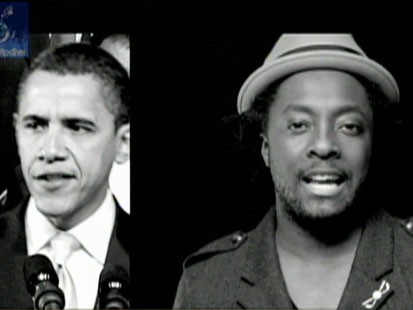
I've never had a lot of fondness for will.i.am or his work with the Black Eyed Peas. But he, and filmmaker Jesse Dylan, have quite possibly made the best political ad in the history of politics.
And it's not actually a political ad. As far as I can tell, there is no intent here to raise money for Barack Obama's campaign. It's a pure tribute to one man's eloquent words and inspiration.
Works for me.
You can see a full-size high quality version of the video, and see a list of performers, at this website.
Wednesday, January 30, 2008
Rumors
I hope it's not true. But if it's true, I hope he doesn't endorse another candidate. Not yet.
John has raised important issues during his campaign, and he has showed himself as a true progressive. Obama's closer to him on several issues than Clinton - and I expect him to eventually endorse Obama - but he's not there yet.
So I hope Edwards gives him a little bit of the ol' treatment before he offers an endorsement. And i hope Obama takes him seriously. He's earned that much.
John Edwards for Attorney General!
Sunday, January 27, 2008
Reality Check - Should Edwards Drop Out?
Well, Barack Obama just killed his remaining two opponents in South Carolina. We've all seen the headlines - Obama wins more votes than both Clinton and Edwards combined. He won in every conceivable demographic (except over 65 - what's that all about?)
But then there's John Edwards - my candidate. Poor, poor, maligned, ignored John Edwards.
Edwards placed third in South Carolina (although he apparently surged more than ten points in the polls before Saturday, while Clinton plummeted). He's been in four races and hasn't won one.
So should he drop out? Is he, in fact, not a viable candidate? Is he just getting in the way of the "real" candidates? Is he wasting time and money and energy by running for a nomination he cannot win?
Well, let's think about it for a minute.
The Democratic nomination is not decided by wins in states. It's decided by total number of delegates. There are a total of 4049 Democratic delegates up for grabs during the campaign. The nominee must win 2025 delegates in order to close the deal - just over half.
This means that the winning candidate can't just get a plurality of the delegates - they need a straight-up 50%. South Carolina is the first state where any candidate won by over 50% of the vote. (There are 45 delegates tied to the primary, and another nine who are superdelegates.) Obama will receive 25 delegates from the primary, Clinton 12, and Edwards 8.
(I'm not some kind of idiot savant, by the way. All of this stuff is available on several websites, including CNN's Election Center.)
Edwards is gathering up the delegates he can, in hopes of making a play at the convention. He hasn't won a state yet, but he is winning delegates in each race. If he wins enough delegates to keep either Clinton or Obama from winning 50%, then he goes into the convention with a tremendous amount of power. Right now, this is a three-way race, not a two-person race.
Hillary Clinton, according to some reports, ignored South Carolina so she could campaign in New York, New Jersey, and California in hopes of racking up delegates. That way, even if she wins less states than Obama, she'll end up with more delegates and be in a position to take the nomination.
This is the way the game is played. This is the system that the Democratic Party has in place with all of the states that have proportional delegates systems vs. winner take all.
No one is gaming the system. No one is cheating the system. Each of them is winning delegates and votes. Each candidate is competing, in their way, with legitimate hopes of winning the nomination. No candidate is out until someone reaches 2025 delegates. Until and unless that happens, each of the three candidates remaining has a shot at the nomination.
If no one gets to 2025 by the time the convention happens, then all bets are off. A brokered convention is not entirely out of the question. It's happened before: as recently as 1976, for the Republicans, when Gerald Ford beat an ex-movie actor named Reagan on the first ballot.
Right now, Clinton has won two states and Obama has won two states. Clinton apparently leads in overall delegates, counting superdelegates, but Obama leads in delegates won from state primaries and caucuses.
But let's look at the numbers.
In the overall race for the nomination, Clinton has 230 delegates, followed by Obama with 152 delegates and Edwards with 61.
So the one who's closest to the nomination - Hillary Clinton - is nearly 1800 delegates short of the mark.
This race is far from over. And it'll be over when all of the voters - not just those in the early states, and not just those voting on Super Duper Double-Scooper Blooper Tuesday - cast their votes. (52% of all delegates will be up for grabs on that day, but no one is expected to win half of those delegates cleanly. It'll be a few here, a few there, some over here, and everybody get out yer blackboards.)
It's over when it's over, and until then, none of the three viable candidates has an obligation to step out for the sake of the party, or for the sake of the "realistic" candidates, or for any other reason.
And lest it be forgotten - John Edwards is talking about issues that the other candidates have only touched upon. He talked about predatory lending before Countrywide collapsed. He launched his campaign, not from New York or Washington, D.C., but from the devastated landscape of New Orleans. Edwards is moving the other candidates to the left, and that is a good thing. He is a unique voice in this campaign, and one that should keep speaking until he is no longer a candidate. That day has not arrived.
Tuesday, September 18, 2007
Clinton and Edwards on Health Care
So I've skimmed Hillary Clinton's health care plan and I've skimmed John Edwards' plan. I'm not an expert on this issue, so I'm not going to pretend that I'm analyzing every single point. What I've done below is to pick out several important differences and highlight them. It should be fairly clear where my loyalties lie by the end.
It's important that both of these proposals are just that - proposals. None of the current proposals are binding in any way, but they can be legitimately seen as statements of principle - where a candidate takes a stand and where they waffle or compromise.
Terminology
There's several significant differences in the plans. You can start with the titles of the plans. Clinton's plan is titled the "American Health Choices Plan: Quality, Affordable Health Care for Every American." The emphasis seems here to be on choice, and rather than use the phrase "universal health care," she uses the awkward phrase "quality, affordable health care for every American." The difference is significant.
The document outlining Edwards' plan is titled "Universal Health Care Through Shared Responsibility." He pointedly uses this quote to introduce the plan:
“We have to stop using words like ‘access to health care’ when we know with certainty those words mean something less than universal care. Who are you willing to leave behind without the care he needs? Which family? Which child? We need a truly universal solution, and we need it now.”Expanding Government Plans
Edwards' plan relies on an expansion of government plans that already cover millions of Americans: Medicaid and SCHIP.
Edwards' Plan: Medicaid and the State Children’s Health Insurance Program (SCHIP) play essential roles in helping low-income Americans getting the health care they need.
Edwards will strengthen the federal partnership with states supporting these programs, committing the necessary federal resources to allow states to expand Medicaid and SCHIP to serve all adults under the poverty line and all children and parents under 250 percent of the poverty line (about $50,000 for a family of four).
Edwards' approach calls for a new "public insurance plan modeled after Medicare, but separate and apart from it. Families and individuals will choose the plan that works best for them. This American solution will reward the sector that offers the best care at the best price. Over time, the system may evolve toward a single-payer approach if individuals and businesses prefer the public plan."
Clinton's plan offers no significant expansion of health care plans. The only concession is a vague line "fixing the holes in the safety net to ensure that the most vulnerable populations receive affordable, quality care." While this may result in expansion of coverage, she does not use that term and I will also not use the term in regard to her proposal.
In the Clinton plan, government's primary responsibility is not to offer expanded health care coverage, but to 'ensure' that private health care is kept affordable and to "implement reforms to improve quality and lower cost." Again, they're supposed to lower cost on private health care plans, not expand the plans that currently exist.
Clinton's plan: will ensure that health insurance is always affordable and never a crushing burden on any family and will implement reforms to improve quality and lower cost.
At one point, Clinton does seem to offer an expansion of coverage - or rather, the creation of a new health care plan, similar to Edwards' plan, that is not Medicare. Individuals will be offered the option of keeping their health care coverage or choosing from a list of private health care options modeled after Congress' current options for health care. She makes no mention of an eventual goal of single-payer coverage. The term "single-payer" appears nowhere in her plan.
[...]the Health Choices Menu will also provide Americans with a choice of a public plan option, which could be modeled on the traditional Medicare program, but would cover the same benefits as guaranteed in private plan options in the Health Choices Menu without creating a new bureaucracy. The alternative will compete on a level playing field with traditional private insurance plans. It will provide a more affordable option, in part through greater administrative savings. It will not be funded through the Medicare trust fund.
Pre-Existing Conditions
Both plans appear to ban discrimination for pre-existing conditions.
Edwards' plan: Edwards will require insurers to keep plans open to everyone and charge fair premiums, regardless of preexisting conditions, medical history, age, job, and other characteristics. No longer will insurance companies be able to game the system to cover only healthy people. Several states – including New Jersey, New York, and Washington – have led the way on similar community rating and guaranteed issue reforms. In addition, new national standards will ensure that all health insurance policies offer preventive and chronic care with minimal cost-sharing.
Clinton's plan: By creating a level-playing field of insurance rules across states and markets, the plan ensures that no American is denied coverage, refused renewal, unfairly priced out of the market, or forced to pay excessive insurance company premiums.
Sticks and Carrots for Business
The Clinton plan offers tax incentives for small businesses. By offering a number of schemes to trim bureaucracy and create health are efficiencies, she suggests that she can make health care more affordable and more efficient. She proposes this as an incentive for businesses to offer health care for their employees.
In return, large employers will be expected to provide health insurance to their employees or make some contribution to the cost of coverage.
"Some contribution" is a meaningless term. Similarly, Clinton does not explain whether employers would be offering subsidies to their employees to buy private health care coverage, or whether they would be recompensating the government for the cost of providing health care for their employees. There is an important and frustrating lack of specificity here.
Edwards' plan: Businesses have a responsibility to support their employees’ health. They will be required to either provide a comprehensive health plan to their employees or to contribute to the cost of covering them through Health Care Markets. In return, the Edwards plan will make it easier for businesses to offer insurance by reducing costs and creating new choices. Covering all Americans will eliminate the cost of uncompensated care. Businesses can also choose to purchase care through Health Care Markets, which will offer quality plans at low prices and with minimal administrative burdens.
The approach is similar, but Edwards is more clear about what businesses' obligation will be if they do not offer health care for their employees.
Individual Tax Credits to Buy Coverage
Both candidates offer tax credits to help individuals pay for health care coverage. The tax credits would be refundable. The Clinton plan would index tax credits to ensure that "health premiums never rise above a certain percentage of family income. The tax credit will be indexed over time, and designed to maintain consumer price consciousness in choosing health plans, even for those who reach the percentage of income limit." The Edwards plan would offer tax credits on "on a sliding scale to middle class families and refundable to help families without income tax liability." The approaches are nearly identical.
The Mandate
I've seen more than one person say that Clinton's and Edwards' approaches are similar in that they would both require individuals to carry coverage. Indeed, Clinton's plan would require individuals to carry health care insurance.
Individuals: will be responsible for getting and keeping insurance in a system where insurance is affordable and accessible.
And ditto Edwards.
Once insurance is affordable, everyone will be expected to take responsibility for themselves and their families by obtaining health coverage.
So are the two mandates identical? Hardly. Edwards mentions a mandate at the end of a long list of goals for improving health, which include:
First: Business Responsibility.
Second: Government Responsibility.
• Offer New Health Insurance Tax Credits
• Expand Medicaid and SCHIP
• Require Fair Terms for Health Insurance
• Secure the Health Care Safety Net
Third: New Health Care Markets.
Only after all of the previous steps are achieved does he call for a mandate to carry health care coverage. He makes it clear that individuals can only be required to insure themselves after the market is made more fair and more affordable and new plans are offered by the federal government.
Timeline
Edwards proposes to cover every American by 2012. Clinton does not include a timeline in her plan, but has said publicly that she hopes to implement her plan by the end of her first term - 2012. She does not say whether every American will be covered by then, or if the plan will merely be in place by then.
There's lots more here than my tired brain can cover. Go look at the plans yourself. Clinton's is here. Edwards' is here. Make up your own mind. But as for me, I prefer Edwards' approach. He is unafraid to call for an expansion of government plans, and he clearly aspires for single-payer coverage. Indeed, his plan deliberately puts public and private plans against each other, with the expectation that more people will eventually choose public plans if given a fair choice on a level playing field. It's a smart idea - allowing the public to lead themselves toward universal single-payer coverage.
Tuesday, January 16, 2007
Obama '08
I just had to restrain myself from walking into my boss' office and telling him that I'd be taking some time off to volunteer for Obama's campaign. I like Obama a lot. I like that he's a former community organizer, something that prepares anyone for talking to everyday people as if they're actual human beings. I like his optimism. I like his gentle, thoughtful speaking style. I've read his first book, "Dreams from My Father" and was impressed with what I read. I don't know if he'll be the nominee, and I have some initial concerns about some of his stances (mostly because of vagueness). But I'm excited about him, and no other candidate has gotten me genuinely excited yet.