(Note: Oliver turns seven this month. In his honor - and just because it's fun to look back - I'm going to repost the story of his birth. I posted this originally on the other blog way back in 2005.)
We knew that today, the great and terrible ordeal was beginning. It was time. Due date #1 (May 21) and #2 (May 26) were both in the rear view mirror. Today, we would begin the process of moving Oliver out into the real world, whether he liked it or not.
Because R's cervix wasn't quite ready yet for delivery, she was scheduled for three doses of misoprostol today. the miso would soften her cervix and ripen it (isn't that a great term? A nice, vivid, moist, squishy word - ripening. We would have quite enough moist squishiness in the next couple of days for both of us.). Her nurse told us very little about how this would go, except that we would have to go to the hospital for each of the three doses, and that it was possible that with the cervix ripening, labor could just start on its own without needing to go all the way to pitocin (which was just fine with us.)
She said only one descriptive thing about the day. "Nine, one, five." Those were the times when we would have to be at the hospital.
9, 1, 5.
So we thought that this would be a day of commuting. We'd drive over to Swedish, a nurse would place a misoprostol capsule - next to her cervix - (a delicate way to describe the process), and then we'd go home for a couple of hours and wait. Go back at one o'clock, repeat steps 2 and three. Ditto five o'clock. That was how we imagined our day. I packed the suitcase (you know, THE suitcase - really just a duffel bag with clothes and stuff) just in case.
We arrived at the hospital. R. undressed, put a blanket over her lower parts. She had two belts stretched over her tummy to measure contractions and the baby's heartbeat. We waited for a little while, and then the nurse came in to examine her cervix. (Nothing exciting yet: 1 cm dilated, long., sorta soft, but not soft enough. The cervix is like the steel door that protects the uterus during pregnancy, and usually it's pretty long. Between 3 and 5 cm in length, in fact. But when it's time for labor, it needs to get soft enough to pass a baby through, and it needs to shrink in length. In other words, it needs to stop being a steel door and turn into a soft, paper-thin passageway. Once it's short and soft, then dilation can start.)
Miso capsule #1 was put in.
And then the nurse told us that she'd be monitored for the next couple of hours.
Uh oh.
"Would you like some magazines?" said the very kind nurse. (I think her name was Heather, but I can't remember for sure.) "We keep a lot of magazines around here." So we got some People magazines, and Marie Claire, and Redbook, and etc.
I know that when I look back on the story of Oliver's delivery, I will remember Tom and Katie, and Oprah, and Renee and Kenny Chesney. I had lots of time to study them during those long, long hours in the triage room.
We waited. We listened to the whooshing of the fetal monitor. I kept thinking of the spaced-out experimental side of Electric Ladyland - the monitor reminded me almost perfectly of the roaring outer-space sounds of "Moon, Turn the Tides...gently gently away." At other times, the constant pumping - and it's not a sound of an actual heartbeat, not the way we're used to it, it's literally listening to the blood rush through auricles and ventricles - I remembered the bell's toll in the elongated bridge of "1983, a Merman I Should Turn to Be." Waiting, waiting, marking time and knowing that something is happening, even if you can't see it. Something is happening in there.
The nurse came in, checked Mrs. B's cervix again, and dismissed us for lunch. We rushed home and grabbed the books that we had foolishly left on the coffee table - they were NOT getting left behind again. We had learned our lesson.
I brought a paperback of Neil Gaiman's "Stardust." It's essentially a fairy tale, a boy's adventure. A young man goes to the outskirts of town, past the gates where no one ever goes, and goes off to the hidden lands to seek his fortune. Seemed appropriate.
We wolfed down food. I seem to remember I did some insignificant cleaning - I vacuumed the living room, or I wiped off the kitchen counters. It seemed very important at the time.
We were back at the hospital by 1. Our kind, and thankfully, not perky, nurse strapped R in again and checked the cervix. "2 centimeters," she announced. It was moving! Now, one centimeter is a ridiculously small increment, but it was the most movement that had happened in weeks. We were excited. Something was happening in there.
Miso capsule #2. There is really no way to describe watching someone else's arm go into my wife up to the elbow, but I felt fascinated (in a completely medical way) and ashamed and voyeuristic. I averted my eyes.
More waiting. More magazines. R could feel some movement, and the monitor helped convince us that things were changing, softening, opening. Woosh woosh woosh.
R had to get up more than once to use the bathroom. The first few times, we asked the nurse to come in and unplug her, and she would go off down the hall, a blanket wrapped around her like a toga, holding the monitor plugs in her hands like electric tails.
We had a tremendous amount of time to think about the significance of the moment. It was starting! The whole new chapter in our life was starting! But we felt like we were trapped in a wating room. I can't say that there was anything foreboding or mystical about the whole adventure, at least at this point.
Our nurse came back to examine R. The miso had run its course, but her cervix was contracting away on its own. We went to dinner at some bistro on Capitol Hill. I remember two things about the whole experience.
I remember dessert: we shared a huge berry cobbler, all baked in a big earthen pot with ice cream melting all over. It was amazing.
And I remember cigarette smoke. The bistro had big glass doors that they would open to let in the air during the summer. (It was the summer, after all.) And some Capitol Hill hipster types were smoking like chimneys on the patio, outside, and letting their smoke blow into us. My pregnant wife, about to give birth, was being forced to inhale these people's cigarette smoke. Didn't they know she was pregnant? ! Didn't they care?!
I finished the berry cobbler in a state of quiet rage. "Don't you smell that?"
"No, not really."
It didn't matter. Secondhand smoke could be odorless. If anything at all went wrong with the pregnancy, I was coming back here with gasoline and matches.
We had to go back for the third miso treatment. R steeled herself - it was eight o'clock already. It was going to be a long night.
Our nurse was off for the night, so another nurse came to take over. But after the inevitable monitoring, and the cervical exam, the new nurse dismissed us. "Your cervix is already working too hard. We don't want to overstimulate it." Apparently, if they gave her a third dose of miso, she would contract all night, and induced contractions can be extremely painful. So we gathered up our books, R got dressed, and we checked out. We were due back at 7 am the next morning so R could be induced.
Wednesday, May 30, 2012


Tuesday, May 22, 2012
They Have Their Own Thoughts
Your children are not your children.They are the sons and daughters of Life's longing for itself. They come through you but not from you. And though they are with you, yet they belong not to you.- K. Gibran, The Prophet
I have this phrase memorized. (I thank Sweet Honey in the Rock for that.) Over and over, my son has taught me the truth of this.
When I try to predict his behavior, he surprises me again and again. I don't know what he's thinking. I can't even pretend. His brain works on a completely different wavelength. That was true before we had the Asperger's diagnosis. It's been true since he was a baby.
And so, there we were, in church this Sunday. I was sitting, patiently listening to my pastor. He was sitting, and then turning, and then sitting, and then sprawled out over the pew, reading a book. And then he put the book on the pew while he knelt on the floor (not for any religious reason - it was probably just comfortable.) He squirmed and wriggled. But he was there with me, and we were together in the church to which I'd belonged for over a decade. And it was comforting, having him there, even though it might not have looked comfortable to anyone watching.
Sure, there are times when I wish he'd adhere more closely to acceptable public behavior. But he wasn't hurting anybody. He wasn't even bothering anybody. He was just being ... different.
Different is fine. Different is not bad. Different is just ... different.
There are times when I see what he's doing and I expect him to think my thoughts. I think to myself, "doesn't he see that this isn't the way people behave in a store?" (Or a church, or a school room, or whatever.) But often, the right answer is ... who cares? So he's a little rambunctious. So he likes counting the stacks of canned vegetables, or he likes rearranging the chocolate bars according to the pattern he prefers? So what if he prefers the taste of frozen vegetables (and I mean frozen as in unthawed, just out of the freezer) to cooked? He isn't hurting anyone. It's hard to discipline someone for different. I never want to punish him just for that.
My sense of normal is not his. He has his own sense of where the line has to be drawn. And so I have to rearrange the way I respond to him. He is not me. He inherited many things from me, but not my brain. He has his own will, his own thoughts, his own heart. He is my child, but he has never belonged to me.

Thursday, May 10, 2012
Saying Goodbye
We went to see the movie "Where the Wild Things Are" in the theaters. We had to. Oliver was about 3 1/2 when it was released, and we went to see it around Thanksgiving.
The movie amazed me. It was powerful and moving and emotionally wrenching. And Oliver was enraptured.
Until he started sobbing.
We had only seen one other movie in a theater before then - the Fantastic Mr. Fox. I knew this one was scarier, and I had a feeling he would react in some way while we were watching. But he didn't run out of the theater when things got scary. That wasn't what happened.

What happened was that during the scene when Max said goodbye to the Wild Things and left them on their island, Oliver lost it. He started wailing. We were in a big, half-empty, cavernous theater, and his cries echoed off the walls and the ceiling. Everyone in the theater could hear it. I'll never forget it: my son, sobbing in his mother's arms, because Max left the Wild Things to go home.
I never read the book when I was a kid. My childhood was full of Richard Scarry and fairy tales and mythology. But I never read "Where the Wild Things Are" until I was an adult, reading it to my son. So I don't know what it's like to experience the book as a child.
I can say this, as an adult now: it's a peculiar book. It has depth and texture that is remarkable for a picture book, remarkable for a book that was published nearly 50 years ago. It's abstract and surreal and pretty weird. There are pages and pages with no dialogue at all: just rumpusing, swinging from trees, running around forests, howling at the moon.
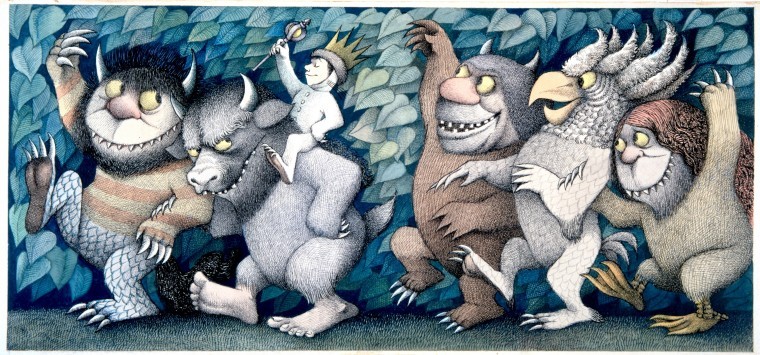
The text doesn't rhyme. There's not even a story so much as the insinuation of a story. Maybe that's what makes it so powerful: the writing is so spare and evocative that it becomes a Rorschach test. People project everything onto it, and they experience themselves when they read it.
It's a pretty weird book.
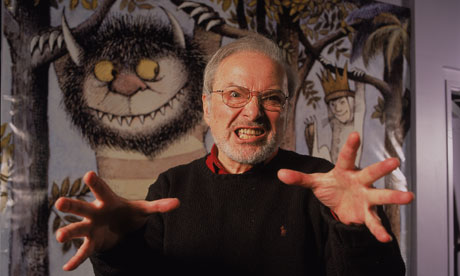
I have to respect someone with a weird vision. Maurice Sendak had a weird vision. His books featured monsters and creatures and scary humans. Kids were eaten by lions, baked into pies, chased by wild beasts. I like that. My son's best friend for years was an invisible monster named Freddy. Sendak didn't write for kids. He wrote as a kid. He understood the terrifying, inspiring, overwhelming way that children experience the world and he wrote about it. Would that we were all brave enough to write about the world in all its terror and beauty.
I never knew Maurice Sendak as a kid, but I love and appreciate his work now that I can give it to my son. I will miss having him in this world. Rest in peace. Or however you choose to rest.
The movie amazed me. It was powerful and moving and emotionally wrenching. And Oliver was enraptured.
Until he started sobbing.
We had only seen one other movie in a theater before then - the Fantastic Mr. Fox. I knew this one was scarier, and I had a feeling he would react in some way while we were watching. But he didn't run out of the theater when things got scary. That wasn't what happened.
What happened was that during the scene when Max said goodbye to the Wild Things and left them on their island, Oliver lost it. He started wailing. We were in a big, half-empty, cavernous theater, and his cries echoed off the walls and the ceiling. Everyone in the theater could hear it. I'll never forget it: my son, sobbing in his mother's arms, because Max left the Wild Things to go home.
I never read the book when I was a kid. My childhood was full of Richard Scarry and fairy tales and mythology. But I never read "Where the Wild Things Are" until I was an adult, reading it to my son. So I don't know what it's like to experience the book as a child.
I can say this, as an adult now: it's a peculiar book. It has depth and texture that is remarkable for a picture book, remarkable for a book that was published nearly 50 years ago. It's abstract and surreal and pretty weird. There are pages and pages with no dialogue at all: just rumpusing, swinging from trees, running around forests, howling at the moon.
The text doesn't rhyme. There's not even a story so much as the insinuation of a story. Maybe that's what makes it so powerful: the writing is so spare and evocative that it becomes a Rorschach test. People project everything onto it, and they experience themselves when they read it.
It's a pretty weird book.
I have to respect someone with a weird vision. Maurice Sendak had a weird vision. His books featured monsters and creatures and scary humans. Kids were eaten by lions, baked into pies, chased by wild beasts. I like that. My son's best friend for years was an invisible monster named Freddy. Sendak didn't write for kids. He wrote as a kid. He understood the terrifying, inspiring, overwhelming way that children experience the world and he wrote about it. Would that we were all brave enough to write about the world in all its terror and beauty.
I never knew Maurice Sendak as a kid, but I love and appreciate his work now that I can give it to my son. I will miss having him in this world. Rest in peace. Or however you choose to rest.
Tuesday, April 24, 2012
Maintenance Work

I'm not afraid of an ultrasound. My wife got about nine thousand ultrasounds while she was pregnant with Oliver, and I was there for most of them. That's not the problem.
A few weeks ago, I started having some weird pain in my back. At least, I thought it was my back. I would do something and it would twinge and I would think, well, it's a pulled muscle or a pinched nerve.
Last week, that changed. The pain wouldn't just come when I turned the wrong way. It was constant. And then one day - this was an awful moment - I was sitting at the same chair I'm in right now, in our home office. My wife and son were both there. I think I turned my head. And then, suddenly, the worst pain of my life erupted. Screaming, teeth-gritting pain, the kind where you have trouble breathing and you want to start pounding your fists on something just to make it stop. It was horrible.
I went to see a doctor a few hours, and he suggested that I had kidney stones.
Kidney stones. They just sound quaint, don't they? Like an old man's disease. Like liver spots. I realize, as I write this, that I had a friend in college who had kidney stones. But still, when I think about it, it sounds like a geriatric illness. I know how wrong that sounds, but that's the way my brain works. I can't help it.
And so, I'm having an ultrasound today to look at my kidneys. If the stone is serious and won't pass on its own, that might require laparoscopic surgery. I've never had surgery in my life. I'm only a little apprehensive of that.
Now, by itself, that would be something of note. But I'm also getting a root canal next week. And shortly after that, I'm having my wisdom teeth extracted, including the wisdom tooth that has been causing me great pain for the past several months. the pain in my teeth and jaw was what convinced me to call a dentist in the first place, and that was the first time I'd contacted a dentist in three years.
So, two major health issues in the course of a few weeks. Neither of them is life-threatening. I'm not going to die from a kidney stone or from a sore tooth. But still, all the procedures and appointments and phone calls feel strange, lined up after one another like confused little dominos. It feels like something is happening.
It could be that my body is falling apart, the consequence of getting old. I'm in my early forties, and it's possible that this is just what happens to people of my age.
 |
| Better. Stronger. Faster. |
Thursday, April 05, 2012
Which is which?

I've slowed down on this blog, and here's why.
I have two different identities. I have my own name, my own identity, online. I'm on Twitter and on Facebook and on myriad other websites, using my given name. I have hundreds of friends IRL - in real life - and hundreds of online connections.
And then there's this identity. This version of me: this identity that I have constructed over eight years, before I had a son. Before Facebook. Before Twitter. Waaaay before Pinterest. My online identity has existed since 2004. I've written about politics, about music, about my family, about popular culture, and a bunch of other things.
And now, I write on Twitter and Facebook and in other places about pop culture, and music, and my family.
See the problem?
So I've had to reassess, constantly, which version of me will exist on this blog. The more I share under my name, the less material I have left for the blog. It sounds odd, but there it is. And the other thing is that I find it somewhat comforting to be able to write under my actual name. I enjoy seeing that there are people who have known me (and met me, and worked with me) who stay in touch with me online.
Every person is a brand now. Every person markets himself and herself with everything they say, everything they tweet, every comment they leave on a blog. And so now I have two brands. It can be a bit confusing at times.
Some people know me on both sides, under both names. A few people. I say things here that I can't say under my own name. Mostly about my employers. (And interestingly, I find that my Twitter stream is mostly used for profane messages about Seattle traffic.)
So there will be things I talk about on both sides. Here, I'm going to talk about my son. My son has been diagnosed with Asperger's Syndrome, and I'm going to talk more about in the months and years to come. It's important. And I can be more candid on this blog than I can under my own identity.
It's important for me to talk about it here because some of you have known me for years and years. I know a few of you used to read this blog back when it was a Salon blog. I have longtime readers - I suppose I could say you're friends, at this point.
I'm still going to talk about my son's diagnosis under my real name. But I can be more honest here, more unguarded. I can talk more about my own challenges, my doubts, the struggles.
In both of my identities, I am a political animal. I am a writer. I am a dedicated husband. And I am the father of a boy who has Asperger's Syndrome. Whoever I am, these are the things that will never change.
Sunday, February 12, 2012
A Tragic End
The saddest thing about sudden deaths is that it feels like someone has been stolen from this earth. All the potential, all the force of their existence, snuffed out like a candle. We always say that they were taken too soon, and it is always true. When drugs are involved, the feelings are even more complicated. We could say we saw it coming, but that doesn't make it right. We could say that someone should have helped. But many people helped, and sometimes, the patient doesn't want to get better. Sometimes, the clutch of addiction is too tight and too comfortable.
Tonight, at the Grammy Awards, Whitney Houston will be honored. She was a huge star, a force of nature, and her loss breaks the hearts of musicians, of music fans, and of millions of people who never knew her personally, but knew her music and her force and her passion.
There will be no tribute to Gil Scott-Heron at the Grammys.

Remember Gil Scott-Heron? He died in May 2011, for reasons that are still unclear. (Like Whitney's death, the cause of death may never be known, or at least, it may never be released.)
Gil was a legend. Whitney was a legend. Both recorded powerful albums that stood the test of time, that serve as touchstones to the eras in which they were released.
Both of them died tragically, horrifically, and under that cloud of suspicion and sadness. Was it drugs? Was it an overdose? Or was it just their bodies, wearing out after so much abuse and misuse and maltreatment?
So my question is this: why is it that Gil Scott-Heron won't receive a tribute?
Their music was fundamentally different. Gil sang (and spoke) about revolution, about crime, about remorse and addiction and injustice. Whitney sang about love.
I mean no disrespect. Both of them had their talents, and both of them are remarkable artists in their own right. Whitney sang with force and authority, but her subject matter was ultimately never going to be ground-breaking.
Gil sang "Whitey on the Moon." Whitney sang, I have nothing if I don't have you.
Gil sang protest music. Whitney sang pop music.
Whitney sang "Didn't We Almost Have It All?" Gil sang "We Almost Lost Detroit," a dirge about the partial nuclear meltdown in 1966 at Detroit's Fermi 1 nuclear power plant.
It is almost unfair to compair the two, and yet, because of the circumstances, they will be compared. Both of them died in the same 12-month period (the same period as Michael Jackson - no doubt he will also be honored tonight.) One will be given a star-studded tribute tonight, before the biggest names in music today. And the other - he will be part of a slide show. He will be "one of those other people who died."
Was Gil a legend? I believe he was. Where would hip-hop be without "The Revolution Will Not Be Televised?" Where would revolution be - or the writers of revolution, who spin his phrase into a thousand different variations: The revolution will be tweeted; the revolution will be on YouTube; the revolution will be livestreamed, et cetera, et cetera, ad nauseum.
Gil influenced jazz musicians. He influenced R & B artists - he was a bluesologist himself, he would tell interviewers. Some would say he helped to create the genre of music that would be come to be called rap or hip-hop. Chuck D - the authorative voice of Public Enemy - said "we do what we do and how we do because of you. And to those that don't know tip your hat with a hand over your heart & recognize."
So why doesn't the recording academy tip their hat and recognize? Well, it's this simple. Gil was a scary man. He was a man who spoke truth to power. His voice was filled with anger. More, it was filled with disappointment: at himself, at his loved ones, at the America that he longed for and that he no longer could believe in.
And Whitney? Whitney was safe. She is safe. This is just the truth. The most controversial thing Whitney Houston ever did, musically speaking, was to re-record a country singer's song as an R & B power ballad. She was discovered by starmaker Clive Davis. Gil Scott-Heron wasn't exactly discovered: he forged his own path to success, from 125th Street and Lenox to the world's stage. He wrote his first novel at age 19. He made people pay attention and didn't care particularly if they liked what he had to say.

Both of these artists' deaths are tragic losses for the world. We mourn the deaths of all like Whitney, like Gil, like Michael, like Don Cornelius, who should be here today and are not. But we should also recognize that a hero fell this year. Gil deserves more than a picture in a slide show. While I'm watching the performances of dance music and weepy ballads and soulful declarations of love, I'm going to be thinking about the other voice that was silenced this year. I wonder what Gil would have to say today about the treatment he's getting from his fellow musicians. Sadly, it probably wouldn't surprise him at all.

Monday, January 16, 2012
Dealing with it, whatever it is
I don't even know how to start this. I want to use some witty introduction, a comfortable joke to ease into it. Maybe some deft wordplay. But I have nothing. So let me tell you what's happening.
My son's got some stuff that he has to deal with. We saw some behavior-related issues last year, but with support from his teachers and other school staff, plus the invaluable help of a therapist that works wonderfully with children, he got better. It wasn't a perfect year, but he ended the year on a good note.
This year - first grade - we saw a lot of the same things. We tried the same kind of techniques that had worked last year, but they didn't seem to be working. There's physical stuff like hitting and getting in other kids' spaces. There's name-calling. Unprovoked incidents with other kids. It's all behavior that we just don't understand.
See, our son used to be the kind of kid who was described as "really centered." Or "zen." "He's so calm," the other parents would say at play dates. And suddenly, we were in our second meeting in two straight years with the principal, the teachers, plus various other school staff. Suddenly, we'd be dropping him off at school and other kids would run up to us and tell us that he was being mean to them. Or that he had written on their book. Or hit them. This happens a lot.
So ... we're talking to people. He's still seeing his therapist, but now we're going the next step. We're doing a deeper psychological evaluation on him, running some tests to see what else is going on with him. We might be dealing with ADD. Maybe some sensory issues (things like heightened sensitivity to noise or crowds). Or maybe something like Asperger's.
So in the last week, I've been coming to terms with the idea that my kid might have some bigger challenges than just having problems at school. It's tough. There was a nice article in a local magazine talking about adjusting to the idea that your kid has special needs. That's a great catch-all term. It covers everything: asthma, ADD, obesity, obsessive-complusive disorder, depression, anemia, blindness, everything. And when you look at it that way, how many of us have kids with special needs? More than a few. Just in my small circle of friends, I know easily half a dozen parents who have children with some challenge or another: cochlear implants, feeding tubes, learning disabilities, ADD. Stuff. Kids have stuff, and they deal with it.
Am I surprised? I guess I'm not. My brother (about whom I've written before) was diagnosed with hyperactivity and had major issues at school. He was probably bipolar, too, or something similar. His mother and I both have anxiety issues, and I'm almost certainly ADD. So, yeah, it's not a surprise when I really think about it.
Am I disappointed? Not in him. This is something that he's facing. Would I be disappointed if my child had leukemia? Or high blood pressure? Or if he had to use a wheelchair? Of course not. He's my kid and he'll always be my kid.
I guess I'm disappointed in the way you are when you expect a sunny day and it starts getting cloudy. You know you can't do anything about it, but you just wish that things had turned out a little differently.
What I know is that he's my kid and I need to figure out what's going on with him. I need to help him. We need to know what we're dealing with so that we can help him cope with it. If that means he ends up in some form of special education, so be it. If that means a different school, fine. Whatever he needs.
Right now, we're learning. As one of my wonderful friends put it, the worst part of this is the WTF period, when you know there's something but you don't know what it is. Once we know, then we can help. Once we know, we can develop strategies and make recommendations and suggest adjustments.
But my job hasn't changed. I will never stop loving this kid or wanting him to be the best possible version of himself that he can become. My job is to help him get there. And I'll do everything I possibly can to make that happen.
Monday, December 12, 2011
Oliver: Then and Now
Over 5 years ago, I wrote this about our little toddler Oliver:
How long? Not very long. Weeks. A month or two. Then he'll be walking. Then, the gates we've erected to enclose him in the living room are going to be nothing more than punch lines. Soon, soon, he'll be walking up to us with the book that we absolutely must read to him at that very moment right there. Soon, we'll be watching him waddle down the aisles of the supermarket, through the doors of the coffee shops and toy stores. He'll walk to the elevator himself, press the buttons himself, and walk us, hand in hand, to the car.
So I remind myself to savor these moments. They disappear before I realize they're gone. I didn't realize until it was nearly too late that the days of bottle-feeding him were nearly gone, back at the end of June. And then it was the last two days that he'd get a bottle from me, and then it was the last day, and then it was the last bottle, the last time he sprawled on my lap to let me feed him. And then, there were no more left.
Bottles. Child-proof gates. Hah.
It just seems so silly to look back on those days, when he still wore diapers, when he still drank milk from bottles. Was that ever our baby?
Our baby - hah! - weighs almost fifty pounds now. He presses the elevator buttons. He not only walks into coffee shops by himself now, but he knows what he wants to order there. (No, he's not drinking coffee. Mostly, it's donuts and fruit plates and the occasional hot chocolate.) He picks out the clothes he wants to wear to school.
He's in 1st grade now. School has been a little bumpy for him - sadly, he inherited anxiety issues from both me and his mom, and we're dealing with that. It's been stressful, for all of us.
So sometimes, it's hard to remember the baby that he once was. And sometimes, that's exactly what I need to remember. This is our boy. This is the same little guy I used to rock to sleep with one arm, the same little guy who had to learn to crawl and then walk and then say words. He learned all that. So he's got other stuff to learn? We all do. We've gotten this far, together. We can get through our little challenges now, too.

Wednesday, November 09, 2011
Blog Ads - No, Thank You.
Why don't I run ads on my blog? Sure, I could make a little money. Maybe I could make a lot of money - who knows? but I also open myself up to having brands on my blog that I don't support.
Say, for example, Filipino dating services.

No, thanks. If I'm going to put embarrassing pictures on my blog, I'd just as soon do it myself.
Tuesday, October 25, 2011
Mushrooms
I live in Seattle. You've probably been told that Seattle isn't really as rainy as the rumors are. Forget that nonsense. Seattle is moist. It's damp. It's a place where lawns either flourish (because of the epic rain) or they die (because the soil drains water so quickly). An old term for long-term Seattleites is "mossbacks." See, because they grow moss on their back! Because ... well, you get it.
I had mushrooms growing in my backyard.
I'm not talking about small cute little mushrooms. These mf'ers were HUGE. Four damn inches in diameter. They were ridiculous.

I didn't see a caterpillar anywhere,
but that wouldn't have surprised me at all.
How long do they have to grow to get to be four inches wide?! Good lord! (And what does this mean about my yardwork skills?)
Now, here's the gross part. I cleaned them up yesterday. The mushrooms were not only huge, but they were DISGUSTING. Some of them were whole and intact and could be removed by the stem. But some of them ...
had rotted. They had liquified. The mushrooms had turned into nasty black tar that stuck to the grass when I picked them up.
You know what happens when you forget about a bag of lettuce in your vegetable drawer, and when you pull it out, it's black liquid. THAT was what I found.
There are now black puddles of ex-mushrooms in my backyard. I'm praying for some of that Seattle rain to wash them away, because it is the GROSSEST THING EVER.
My theory is that these were actually the zombie mushrooms. I found the ones that had died and then reanimated to zombify their fungal brethren. Except, they're mushrooms, so they're plugged into the ground. And that's why they liquified where they stood, like an incredibly gross version of what happens to vampires in Buffy.
Come to think of it, that would have been better. Why couldn't they have just exploded and turned into powder?
Thursday, September 15, 2011
Because We Care

I was talking to one of my co-workers recently. As I mentioned recently, the department has been gutted, so there's not a lot of us left and we're all dejected.
There was some material that went out and it wasn't up to our usual standards. It was terrible. A typo, poor wording, just not our typical quality. My co-worker is pretty frustrated about how far we've fallen.
But she turned to me and she said, " I don't know why I still care. I should be numb to all this. I shouldn't care anymore."
But yet, she still cares. Even though most of my department has one foot out the door, even though some of us (not me!) have been surfing job postings during our work hours, we still care. She is a dedicated worker, a gifted writer, a perfectionist. But the controls have been taken out of our hands. Other people are making the decisions for us, and the decisions are terrible.
But we still care. We're humans. We care about the work we do. We care about what goes out with our name on it. We - and I'm talking about my co-workers - are passionate about their work and it hurts to see poor quality product going out. So we fight our battles, and we argue with our superiors, and we complain behind the scenes when the decisions don't go our way. But we still care.
We could walk away, but there's something in all of us that is still hopeful that even though the iceberg has struck, even though the hull is taking on water, that the ship will be righted. We are hopeful. We have to be.
Sunday, September 11, 2011
9-11-01 - The Aftermath

It seemed to take the entire day on September 11 before we understood everything that had happened. Wild rumors filled the air. There was a car bomb at the Department of State, a fire at the Pentagon (that was the third plane), attacks on the White House. There was no Twitter, no Facebook, no instant news alerts via email. CNN's website crashed multiple times on 9-11 until they stripped it down to an all-text bulletin page. I kept trying to get the correct details. I wanted to know exactly where the plane hit the Pentagon, how many people were on board the planes, where they flew from, how they had been taken. What had happened in Pennsylvania.
I flew a month afterward. I had to go to Chicago for a conference. They had ratcheted down security so tightly that the lines to board planes went all the way out of O'Hare Airport and back around through another door. I remember seeing National Guardsmen patrolling the airport in camouflage, rifles strapped to their chests, at the ready.
September 11 really threw me out of my orbit. I couldn't stop listening to the news. Something about the way I had found out about the attacks after they were in progress got to me. I wanted to know when the next attacks were happening. Especially if they were going to be happening on the west coast. (Years later, it was revealed that the plan was to attack targets on both coasts, and that one of the potential targets was the tallest building in Seattle.)
I couldn't turn off the news. I watched the national news every night - something that I never did before. I became depressed, haunted, fearful. I worked in downtown Seattle, and we have an airport ten miles away, so planes fly over the city constantly. For months, every time I saw a plane flying near one of the tall buildings, I would watch it until I saw that it passed the building and didn't fly into it.
I ended up going into therapy, and I was taking medications for a while until I was able to regain control. But I still look periodically when a plane is flying low over the Seattle skyline.
About my girlfriend? Well, in September 2001, I had started saving up for an engagement ring. In November, at our favorite Brazilian restaurant, I fell to one knee and asked her to marry me. We've been married nine years. We're happy.
I'm not going to talk about the war on terror, or about homeland security, or about politics. I wanted to take a few minutes to talk about the effect of this on me, because this was an attack on us. This affected all of us, as a people, as a society, as a generation. We have survived, but we are not the same, and we may never be. The world into which my son was born is different than the one I used to live in, in so many ways. I hope his world learns to move past fear, past anger, past hatred. I want him to grow up full of hope, not full of fear. That's the world I'm trying to create for him.
9-11-01 - That Day
My brother, who was kind enough to let me stay in his apartment, woke up shortly after the tv went on. He heard me pacing back and forth. "What's going on?" I think I gave him a brief synopsis, or maybe I just pointed at the screen, at the Towers on fire.
At some point, the towers collapsed. I didn't realize that this was going on. It seemed impossible, despite the flames and the impact of a fully loaded commercial airplane. How could one of the World Trade Centers just collapse to the ground? I thought it was part of one floor, or a facade or something. But not the whole building. My brain refused to process it until later, when I saw the collapse over and over and over again.
I went to my doctor's appointment. It was shockingly quiet. We all felt like we wanted to be elsewhere, with families, with loved ones. The radio was on in the background.
Then I went to work. The office, full of social justice activists, was a mix of shock, fear, and rage. A co-worker told me, resignedly, "This is going to be bad, man. There's gonna be a war." I knew she was right.
I worked with people who knocked on doors and called people and asked them to contribute to the fight for social justice. There was no canvassing to be done on that day. No one would answer the phone, we knew, and no one would dare answer their door, especially if it meant stepping away from the television. The office was closed for the day.
I went to find my girlfriend, who was also home from work. We watched tv for hours and hours. Peter Jennings manned the ABC front desk for an eternity, showing impressive dedication and only occasionally letting his own churning emotions show through. I grew to love Peter Jennings for what he did that day. We sat and soaked in the overwhelming news of the day, unable to move, unable to believe what had happened.
But I kept seeing the parade of Bush-appointed officials across the screen - Dick Cheney, Donald Rumsfeld, John Ashcroft. I remember thinking that if this was going to be war, if we were truly under attack, these were not people that I trusted. I didn't trust them with our country. I didn't have faith that they would watch our best interests. I was right, I'm sad to say.
We lived in Seattle, which was now considered a possible secondary target. We were a major city on the west coast, with a critical port and major technology companies in our area. Strikes on the East Coast and the West Coast seemed a distinct possibility. This idea haunted me for weeks - months - afterward, the idea that I lived in a city that could be described as "potential target of terrorism." We had already had our brush with terrorism in 1999 when Ahmed Ressam was arrested, claiming he was part of a plot to blow up Los Angeles' airport.
We went out to dinner that night at a pizza place in the University District, one of the few restaurants that was open. The owner was from the Middle East - Lebanese? I can't remember. But I remember he said that we would now understand what the rest of the world felt. I was surprised at his blunt statement. He was right, of course. For much of the world - England, Europe, Africa, Russia, South America - terrorism had happened in their country and was expected to happen again. They understood that they were vulnerable. Americans had always believe that they were untouchable. Our sense of safety had been obliterated.
I also remember thinking - and maybe I said this out loud to him - that he should be careful saying things like this out loud. Emotions were running high, and statements like that could be interpreted as support for the attack. Of course that's not what he was saying. He was just expressing a statement of fact. But people don't always react well when their sense of reality has been shattered. People who feel under attack can lash out in the worst and most unAmerican ways. We all found that out, as a nation, as the aftermath of Sept. 11 unfolded.
Saturday, September 10, 2011
9-11-01 - How It Started
I was sleeping. I was so busy - I had three events in four weeks to help organize. I think I had an event that morning. I know I had a doctor's appointment. There was something - a hand cramp, something - I wanted to see a doctor about.
I was awakened by the phone. My girlfriend of 11 months - who would become my wife the next year - was on the other end.
"Are you listening to the news?" We were both NPR junkies. I didn't want to tell her that I was still rubbing the sleep out of my eyes.
"No," I answered.
"You'd better turn it on." There was a tone in her voice that I'd never heard before.
I turned it on. I listened, baffled and scared.
Then I turned on the television, and watched the unbelievable, undeniable images. I turned on the computer, turned on the internet connection, opened CNN's website. It was slow to load, because everyone was doing what I was doing.
That was how the day began for me. How did it start for you?
Thursday, August 18, 2011
Changes Abound

So ... I still have the job.
Yep, still working.
Ahem.
I've been watching the second season of Mad Men, and I'm starting to feel a lot like Harry Crane. At this point in the series (and PLEASE don't let me know what happens from here), Harry has invented a job for himself as the head of the television department, and suddenly realizes it's a lot more work than he expected. He's having a little bit of dread, actually, about how much work it's turned into, and how much harder he has to work than he expected.
I'm also feeling a little bit like ... oh, I don't know. Picture any movie you can imagine where the pilot of an airplane passes out, or dies, or turns into a three-headed dragon. And then the co-pilot/stewardess/stunned passenger in row 14 suddenly has to take over the plane. Yeah. Maybe that's it.
So as I said, I still have my job. My boss, however does not. Several of my co-workers also do not. My department has been gutted. My wing of the office is in tatters, and every day I walk in feels like entering a funeral home.
Oh, and also? We have a major product launch scheduled for the fall.
Wiser people than me might ask - why destroy the marketing department when you need them to do nationwide marketing? There are many reasons for that. Mostly, it comes down to money. We made some major mistakes, lost some money due to missteps, and we needed to bring down our labor costs to stay afloat. I didn't say I was working for a well-funded operation, people. Even though it's a bigger office than I've ever worked in, and a bigger outfit than I've ever worked for, it still just takes one mistake to throw everything off kilter. Some things never change.
So we're doing some innovative things. If you want to interpret "innovative" as "desperate," you can. We've contracted out with a marketing firm that might or might not be capable of doing what we've asked them to do. We're asking some people with very little communications experience to pinch-hit. And I'm suddenly being asked questions that I am absolutely incapable of answering. I get calls at least once a week that would have gone to the communications director before, but now he's not there, and nobody else is stepping in to take their place, and so they call me because ... well, I answer the phone. That's why they call me.
So to sum up - I'm in over my head, my boss is suddenly gone, my work is about to get really really crazy, and people are panicking. Everyone I talk to is either actively looking for a new job or they're getting their resume ready, just in case. The lifeboats are being readied.
Meanwhile, I just come in every day and do my job. I send out the messages I need to send out. I follow orders. I keep busy. I ingratiate myself with my new boss, who apparently thinks the world of me.
But I'm still working. And y'know what? I'm just going to be grateful for that.
Thursday, July 21, 2011
Exercise and How It Is Killing Me

People, I'm not saying this to brag, but I just did 113 pushups.
Not all at once. I did 20, and then 25, and then 20 more, and 20 more, and then twenty-eight bicep-murdering pushups. And then I collapsed on the carpet.
I've been doing this 100 pushup program - you know the one, where you work your way up gradually over a series of punishing weeks and you end up being able to do 100 pushups in a row and impressing all the ladies? Okay, that bit about the ladies wasn't anywhere in the description. But why else would a self-respecting man inflict himself to this kind of torture?
My arms are shaking. My hands are a little jittery from the exertion. I'm sure that, to my wife, it sounds like I'm being stabbed repeatedly.
You know that Shel Silverstein song where he says all these ridiculous things that happened to him, and then at the end, he says "And guess what happened next? I died!"
It feels like that.
Tuesday, July 05, 2011
All American
Last night, on July 4th, we seriously had this for dinner.
Hamburgers.
Potato salad.
Corn on the cob.
And watermelon.
I was not wearing a red-white-and-blue straw hat, but I might as well have been.
After the kid went to sleep, we made margaritas. We've been married almost nine years, but it's the first time we ever made margaritas at home. My wife and I both looked at the glass and said "there's a lot of booze in this!" (It was a combination of shock and appreciation.)
A note? Homemade margaritas are delicious. Mrs. B picked up a sack of key limes, so we had fresh squeezed lime juice. AWE-SOME.
Sunday, June 26, 2011

Friday, May 27, 2011
I'm Still Here!!!
Hey!
I know, I haven't written in two months. And you probably haven't read this blog in two months, either. (Because, y'know, math.)
So I figure I need to do something striking to get your attention back.
So here's something striking. My son, Oliver?

Y'know, this kid?
He's turning six.

Yes, really. Six years old.
He's finishing kindergarten next month.

He's reading now. He reads up a storm. Sometimes, he gets out of bed and starts reading books, and two hours later, he's still sitting on the couch, tearing through book after book after book.

He's grown so much this year. Such a personality he has. He's witty and charming and mischievous (like his dad, I suppose. The mischievous part.)

He's big. My kid is getting big.
Monday, March 28, 2011
A Genuine Hero

One of Seattle's finest citizens, Irene Hull, has died.
A week to the day before her death, she attended her Communist Party club meeting in Seattle. Someone announced the Saint Patrick's Day rally in Olympia to protest budget cuts and to demand that the legislature "tax the rich." Hull spoke up: "I'll go if someone picks me up."
She was a tiny dynamo, two inches shy of five feet tall, barely over 100 pounds. She became a national labor heroine when the Seattle chapter of Jobs With Justice (JwJ) published a poster in 1995 of several enormous police officers arresting Irene Hull.
Lonnie Nelson, a Seattle JwJ leader and a member of Irene's CP club, recalled that day. "It was during a sit-in at Republican Party headquarters to protest their attacks on Medicare," Nelson said. "When the Seattle police told Irene to move, she told them, 'I'm going to go limp.'I was privileged to get to know Irene when I was a community organizer. I took her to a couple of rallies and protests in Olympia. I sat with her at labor meetings and saw her at just about every protest I ever attended in the state of Washington. When I marched with 50,000 labor activists during the WTO protests, Irene Hull was there.
"So they handcuffed all of us, hauled us out and put us on a transit bus and took us to the county jail," Nelson continued. "They had us in jail for hours. We sang union songs. We talked about standing up against the vicious Republican attack on Medicare. Through it all, Irene's big concern was my wrists aching from those tight handcuffs." Nelson laughed merrily at the memory.
She was one of the most dedicated and selfless people I've ever known, and a genuine hero of mine. Without her, Seattle may be a quieter place, but it will surely be a sadder place.
Subscribe to:
Posts (Atom)